
Eco-fiction-February – 3 Tales of Nature and Transformation reviewed

During the past month, I’ve been on a bit of an eco-fiction-kick, picking up stories that deal with environmentalism, nature vs humanity, and growth and transformation in various ways. Today, I want to combine 3 recent releases- each with their own spin on this theme – and review them side-by-side. From young-adult horror to literary fiction with a speculative twist; modern eco-fiction has something for everyone. Despite the fact that I didn’t rate any of these books very high individually, I still really enjoyed the experience of reading them in tandem, and thinking about their connections and differences and would love to do these thematic-clusters more in the future.

Arborescence by Rhett Davis:
an intimate arboreal portrait of growing apart

Genre: speculative fiction
Publication: Fleet, January 2026
My Rating: 3/5 stars
“I think for a moment. This has been happening to her for years. It’s been happening to us for years. There’s only so much energy to go around. We’re in a room with no exits and limited oxygen. It was always going to happen, this correction. I’m surprised at how gentle it is. It’s a calm but unsettling rebalancing. It hurts, it takes, and those of us who remain are left with enormous grief. But it’s not death. It’s not a sudden, great, cataclysmic end. If it eventually comes for us all, if the entire planet becomes covered with our wooden bones and new shoots, if the world goes back to green and sky, would it be so bad?”
The Story:
We follow Bren and Caelyn, a couple in their twenties, straight out of college, finding their place in life and their respective careers. Their holding-pattern is broken when a strange video goes viral on social media: a cult of people who’ve given up their modern lives and have chosen to stand still in the forest. These “Arborealists” believe that if they stand still for long enough they will transform into trees. The idea is absurd, but it's spreading. Soon, people start to go missing and trees appear in unlikely places.
Caelyn, disregarding academic ridicule, becomes convinced there’s something to this, and decided to dedicate her PhD-thesis to the strange phenomenon. Meanwhile, in their fast-changing lives, Bren and Caelyn begin to drift apart, and are forced to question what it really means to be human - and if they are ready to stand still.
Thoughts:
Aborescence takes a handful of large speculative ideas in terms of dystopian worldbuilding, but chooses to narrow the scope to a hair-focus, isolating an intimate character portrait of two partners drifting apart. At its core, this is a story of two young-adults, attempting to keep up with a far too quickly changing world, and feeling like it’s passing them by. It’s a feeling that many people (including myself) will recognize, and the melancholic conveyance of this feeling is where the novel shone for me. Both Bren and Caelyn struggle to move through their lives at their own pace ánd struggle to synchronize the pace of their individual lives to each other.
This intimate, character-driven scope is deliberate, but it’s also the ground for the books downfall for me. In the background, we get glimpses of the larger world, and are introduced to secondary themes: ecological collapse, the global rise of AI that’s making Bren’s job obsolete, and obviously the “pandemic” of arborescing people). Yet none of these themes feel quite developed enough and often felt like their inclusion spread the novel too thin. These brief glimpses into the larger world felt insufficient to truly deepen the story, whilst taking away from the development of the characters. In a merely 250 page book, there simply wasn’t enough page time to justify that.
Finally, there was the ending, which really let me down. Without going into spoiler-territory: I felt like much of Brens character-arc was focused on being stationary, and never committing to choices. When he finally does commit to a drastic choice in the end, the closing chapters take this choice away from him, regressing his arc with a kind-of Deus-ex-Machina.
Overall, I felt this book was a great conversation starter, but as a standalone novel, it was a little too flawed to be more than a single tree in the forest of eco-fiction novels that are out there. 3 stars.
Pedro the Vast by Simón López Trujillo:
a thoughtprovoking novella about growing larger than your individual self

Genre: speculative fiction, novella
Publication: Algonquin Books, January 2026
My Rating: 2/5 stars
“If a mushroom were to colonize a human brain, would it think the same things as we do?”
The Story:
Our story begins on a Eucalyptus farm in rural Chile, with the collapse of several minimum-wage plantation-workers from an as of yet unknown disease. Four of them die, of what turns out to be a new fungal disease, which has jumped to humans for the first time. The fifth person wakes after an extended coma, but is irreversibly changed.
The story of our miracle survivor Pedro fascinates his community, including a mycologist studying the pathogen, as well as a local priest, convinced that there was a deeper prophetic meaning to his survival. Through multiple perspectives, including the aforementioned priest, scientist and Pedro’s children, we explore the ripple-effects this fungal incident had on the lives of a local community, and perhaps the world over…
Thoughts:
Where Arborescence took a narrowed focus on individual characters and their lives, Pedro the Vast casts a far wider net (or should I say “mycelium”), and focusses on a community at large. Each character only gets a small vignette or chapter at a time and – to my surprise – Pedro himself probably gets the least page-time. As a result, we never truly get to know a single one of them, outside of their role in the whole. Arguably, this is a deliberate choice, considering the fungal-metaphor of “the vast”. Unfortunately, for a character-driven reader like myself, this kept me at a noticeable distance from the story.
That being said, there’s a lot of social commentary packed into this slim novella, specifically regarding religion, community and the impact of exploitative agro-corporations on Chilean culture.
It’s probably mostly a matter of taste and previous reading-experience that I enjoyed this novella the least out of the 3 I’m presenting today. The concepts of parasitic fungus – and their use as a metaphor for interconnectivity – is a familiar one I’ve read before, and I didn’t feel like this novella truly expanded that familiarity in new ways. If this is your first introduction to these themes though, I think a slim and compact novella like Pedro the Vast would make for a perfect entry-place, and I would recommend it to newer readers exploring this genre.
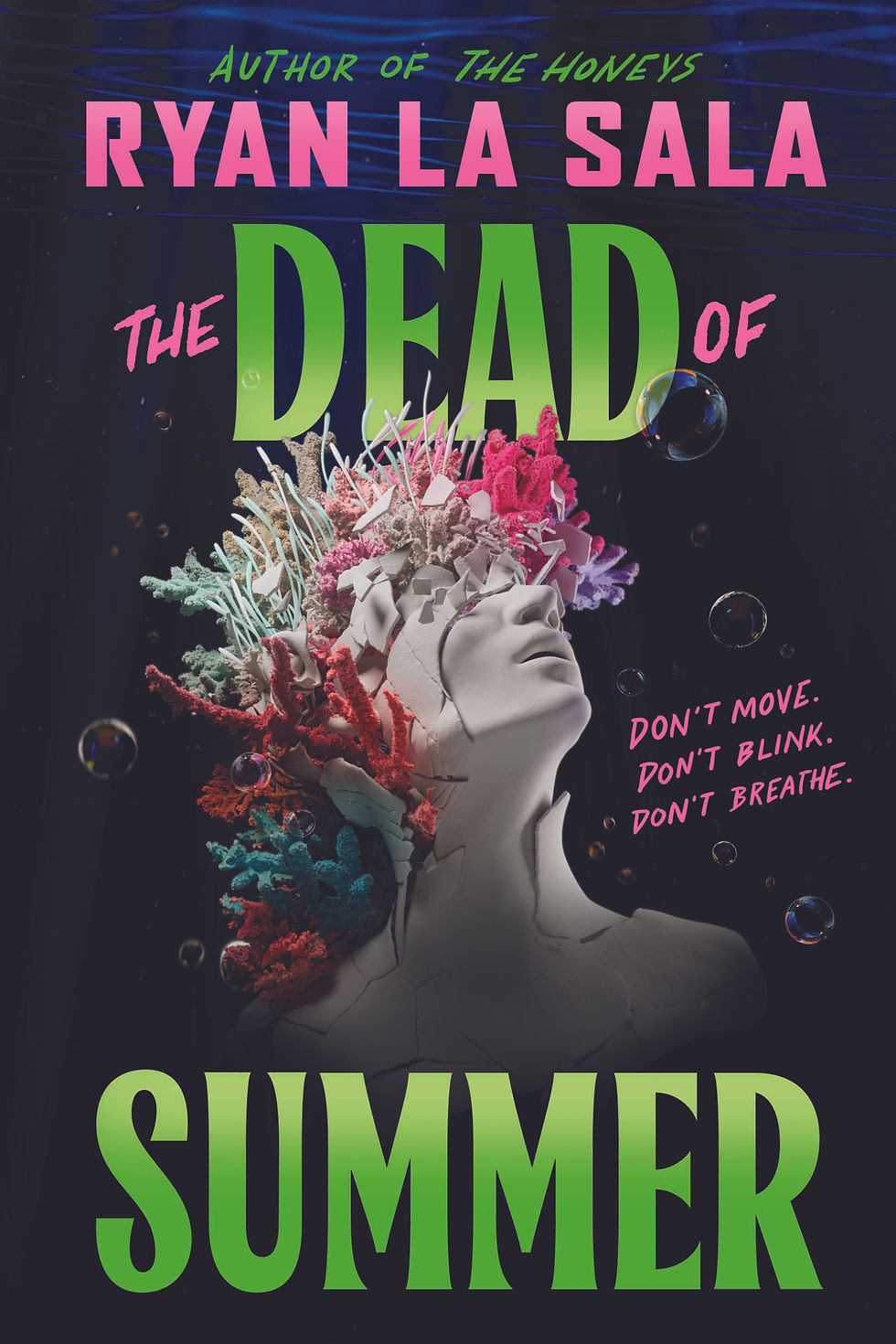
The Dead of Summer by Ryan de Sala;
a YA oceanic horror about growing up
Genre: young adult horror
Publication: Scholastic Media, September 2025
My Rating: 3.5/5 stars
“We do not end, we echo.”
The Story:
Ollie Veltman is finally coming home to the quaint island of Anchor’s Mercy – a fictional, almost utopian beach-destination where the queer outcasts of society have founded their own LGBTQ-positive community. Having just beaten cancer, Ollie’s mother is determined to make this the best summer ever, but Ollie – still reeling from his mother’s illness and left with plenty of questions about it – isn’t so sure… Once back in Anchor’s Mercy, the town is shaken up by a storm that descends upon the island. In its wake, a long-sunken contagious horror rises… Soon Ollie finds himself in a desperate life-or-death-search for answers, with only his friends to rely on.Told partly in real-time, and partly through interview-notes with the survivors, we uncover the story of an ecological outbreak, hidden below the surface for generations.
My Thoughts:
And now for something completely different; from adult speculative fiction, we move to young-adult queer horror. Ryan la Sala’s The Dead of Summer is what I’d describe as “the Last of Us, but with an almost fully queer-teen cast, and coral instead of fungus.” If you just cringed at that description; avoid this book. If on the other hand, that sounded amazing to you, I don’t see how you could not love this book.
Compared to the other books, this is far more action-packed and horror-coded, and in fact, I couldn’t help but feel like this read like a Netflix-show. Ryan la Sala’s prose is stunning, and the imagery he crafts is unforgettable (and completely up my alley with its ocean-inspiration). The more action-packed scenes are tight and I actually held my breath during one of them alongside the characters. If you’re familiar with la Sala, you won’t be surprised to hear how great the LGBTQ-representation is here. As a Dutchy, fortunate enough to grow up in a community where the celebration of queerness, crossdressing and pride where just part of life, I’m at risk of underestimate how powerful this is. That being said; hats off to la Sala for writing this community, its friendships and its queer-star-cast (looking at you, Wendy-Pretendy) in a way that I’d love to visit this fictional community for a holiday.
On an objective level, this is a strong 4-star book, and I’ve rounded it up as such on Goodreads. For me personally, it was more of a 3-star reading experience, mainly because I’m clearly not in the target-audience. Mixed-media isn’t my thing, and I’m clearly older than the YA-demographic this book is aimed at. Regardless, both the story and the characters read very “young” to me, even for a YA-novel. Although they’re supposed to be around 17 to 18 years old, their language, their behaviour and the way they constantly refer to themselves as “the kids” vs “the adults” in town, made them come off more like 14-15 year-olds to me. The story itself, although interesting in its concepts, remains fairly simple and surface-level. There are hints at a deeper history of the town, but we only learn of it through conveniently expositional dialogue and diary-entries. It’s possible that we explore more of this in the sequels, which I hope will be the case.
Oh, did I forget to mention that this is in fact the start of a series?! Probably because I didn’t know myself going into this story, which explains the whiplash I felt with the slightly open ending we’re left with. Similarly to the previous two novels – although for different reasons – here too, we are left with the start of a conversation, where the last word hasn’t been said. Except in this case, there’s the promise of more on the horizon from this author.
If you’ve read and enjoyed any of these t(h)ree books, or anything else that would fit this theme; feel free to chime in on the conversation and leave your recommendations below. Links to the books respective Goodreads-pages are provided below.


Whether you're at home, at school during a break, or relaxing after work, Free Web Games provide instant entertainment wherever you have an internet connection. Fun is always just a click away.